
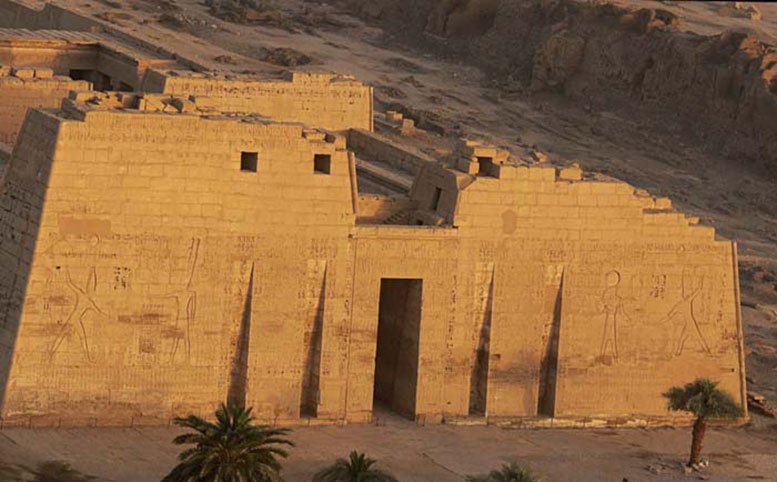
Medinet Habu
Medinet Habu, The Mortuary Temple of Ramses III. is located across from Luxor as part of the necropolis in Medinet Habu.
The cult building, built as a million-year house, was used in particular to worship the god-like pharaoh. In addition to the main temple, the temple complex also includes other monuments: an Amun temple, funerary chapels of the wives of Amun and the Holy Lake.
We Provide Luxury Hurghada to Luxor Trip with low Cost, Booking now.
The temple complex in Medinet Habu is 315 meters long and 205 meters wide. A mud brick wall which was around 10 meters thick and 18 meters high, surrounds the temple and is still very well preserved. It generously surrounds the temple complex.
The so-called “High Gate” is the main entrance, the well preserved wall reliefs show the downfall of the pharaoh’s enemies. Rooms above the main gate were used by Ramses III. himself. A quay was once located in front of the gate, which ensured shipping on the Nile from Medinet Habu.
The passage to the forecourt of the mortuary temple within the surrounding wall is framed by two tower-like buildings, inside the passage itself there are two statutes of the goddess Sachmet.
In the northwest, shortly after the gate to the forecourt of the temple of Ramses III. are the tomb chapels of the wives of Amun, to the northeast is the Amun Temple, the oldest building in the temple complex.
Medinet Habu:
The palace joined with the actual mortuary temple and served as a residence for both this world and the hereafter.
The mortuary temple of Ramses III is built like an ordinary Egyptian temple for worshipping gods: 1st pylon, 1st courtyard, 2nd pylon, 2nd courtyard, Most Holy place. In Ramses III.’s mortuary temple, the first pylon has monumental dimensions (63 meters wide and 20 meters high).
The first courtyard is lined on the right by Osiris pillars, on the left a colonnade of columns defines the temple and the cult palace behind. The second, somewhat smaller pylon is followed by the second courtyard. It is symmetrical and smaller.
Its passages at the front and back are dominated by eight Osiris pillars. Five columns are on the right and left in the shape of papyrus rolls. The last part of the mortuary temple is the place of the holy sacrament, which is surrounded by formerly roofed rooms. Two groups of rose granite statues mark its place.
The special feature of the mortuary temple in Medinet Habu are the numerous reliefs, in which the former painting can even still be seen.
Mainly reliefs of war decorate the walls on the inside of the temple, the reliefs on the outside walls are also still in good condition; the relief of wild bull hunting as well as the land and sea battle against the sea peoples should be mentioned here.
Excavations around the temple at Medinet Habu near Luxor brought an entire city from the Pharaonic era to light. What makes it unusual: the west side of the Nile was actually considered the realm of the dead in ancient Egypt,
Cheek our Hurghada Reisen page.

Medinet Habu Luxor, The Mortuary Temple of Ramses III.
Medinet Habu
Medinet Habu, Der Totentempel des Ramses III. befindet sich gegenüber von Luxor als Teil der Nekropole in Medinet Habu.
Der als Millionenjahrhaus errichtete Kultbau diente insbesondere der Verehrung des gottähnlichen Pharaos. Neben dem Haupttempel gehören zum Tempelkomplex noch weitere Monumente: Ein Amun-Tempel, Grabkapellen der Gottesgemahlinnen des Amun sowie der Heilige See.
Cheek Our Hurghada nach Luxor, Get Best Prices with us.
Der Tempelkomplex in Medinet Habu misst 315 Meter Länge und 205 Meter Breite. Eine Mauer aus Lehmziegeln, die rund 10 Meter stark und 18 Meter hoch war, umfasst den Tempel und ist noch immer recht gut erhalten.
Sie umgibt den Tempelkomplex großzügig. Das sogenannte „Hohe Tor“ stellt den Hauptzugang dar, auf den dort dargestellten Wandreliefs ist das Niederwerfen der Feinde des Pharaos zu sehen.
Über dem Haupttor befanden sich Räumlichkeiten, die von Ramses III. selbst genutzt wurden. Vor dem Tor war einst eine Kaianlage angesiedelt, die den Schiffsverkehr auf dem Nil auch von Medinet Habu aus gewährleistete.
Der Durchgang zum Vorhof des Totentempels innerhalb der Umfassungsmauer wird von zwei turmartigen Bauten eingerahmt, im Durchgang selbst stehen zwei Statuten der Göttin Sachmet.
Kurz hinter dem Tor zum Vorhof des Tempels von Ramses III. liegen nordwestlich die Grabkapellen der Gottesgemahlinnen des Amun, nordöstlich befindet sich der Amun-Tempel als ältester Bau des Tempelkomplexes.
Medinet Habu:
Der Palast grenzte an den eigentlichen Totentempel an und diente als Wohnsitz sowohl für das Diesseits als auch für das Jenseits. Aufgebaut ist der Totentempel des Ramses III. wie ein gewöhnlicher ägyptischer Tempel, der der Götterverehrung dient: 1. Pylon, 1. Hof, 2. Pylon, 2. Hof, Allerheiligstes. Der erste Pylon ist im Fall von Ramses III.
Totentempel ein Hauptpylon mit monumentalen Ausmaßen (63 Meter breit und 20 Meter hoch), der erste Hof ist rechts gesäumt von Osirispfeilern, links grenzt eine Säulenkolonnade den Tempel gegenüber dem dahinterliegenden Kultpalast ab. Dem zweiten, etwas kleineren Pylon folgt der zweite Hof. Er ist symmetrisch und ebenfalls kleiner.
Seine Durchgänge vorn und hinten werden von jeweils acht Osirispfeilern dominiert. Rechts und links befinden sich fünf Säulen in Form von Papyrusrollen.
Den letzten Teil des Totentempels bildet das Allerheiligste, das von ehemals überdachten Räumlichkeiten umgeben ist. Zwei Statuengruppen aus Rosengranit kennzeichnen dabei seinen Ort.
Das Besondere des Totentempels in Medinet Habu sind die zahlreichen und sehr beeindruckenden Wandreliefs, bei denen an vielen Stellen noch die einstige Bemalung erkennbar ist.
Hauptsächlich kriegerische Darstellungen zieren die Wände an den Innenseiten des Tempels, auch an den Außenwänden sind die Reliefs noch immer in gutem Zustand; hier sei vor allem das Relief der Wildstierjagd sowie die Land- und Seeschlacht gegen die Seevölker genannt. Außerdem auffällig: die außergewöhnlich tiefe Einarbeitung in den Stein.
Ausgrabungen rund um den Tempel von Medinet Habu bei Luxor förderten eine ganze Stadt aus der Pharaonenzeit zutage. Ungewöhnlich daran: die Westseite des Nils galt eigentlich als das Totenreich im Alten Ägypten,
Cheek our Hurghada Reisen page.
.

Medinet Habu
Leave a Reply